
Complex Odoo projects have many entities, countries, legacy systems or integrations, and sometimes all four. The ten Odoo Gold Partners below have the headcount, the references or the rescue record to be considered for that kind of work.
Brainvire and Control ERP lead the list, and eight more Gold-tier partners follow. On a hard project, Gold status is the minimum, so ask each partner for a reference as difficult as yours.
1. Brainvire
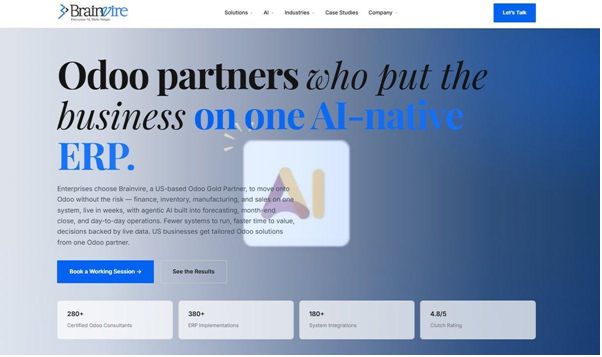
Headquartered in Texas, Brainvire holds Odoo Gold status across the USA, Canada, APAC and EMEA. It works from US offices in Irving, Plano and Hicksville, with delivery hubs in Dubai, Mumbai and Singapore, and its consultants are Odoo 19 certified.
On record, Brainvire’s Odoo practice counts 380+ completed implementations, 180+ integrations, 280+ certified consultants and a 4.8/5 rating on Clutch. It was a Best Partner North America 2025 finalist at Odoo, and 95% retention across 2,000+ brands suggests clients stay.
Discovery workshops turn a loose ERP wish list into a costed, phased plan before any build starts. Partnerships with Adobe, Shopify Plus, OpenAI, Microsoft, SAP, Salesforce and Databricks let the team connect Odoo to almost any surrounding system, and its flagship case put a Fortune 500 fuel and energy retailer on one Odoo 18 ERP and POS platform across 700+ sites in 12 countries. Its flagship 700-site rollout across 12 countries is a useful test of complexity, and the team applied one standardized Odoo 18 core to it.
What Brainvire Delivers
- Implementation
- Migration and Upgrades
- Customization and App Development
- Odoo.sh Hosting and DevOps
- Third-Party and ERP Integration
- Support and AMS
- POS and eCommerce
- BI and Analytics
Industries: Retail, Store Solutions, Manufacturing, Jewelry, Automotive, Real Estate, Healthcare, Education, Logistics.
Delivery is run as a business program, not a software install, with Odoo ERP consulting, managed hosting and application management support behind it.
2. Control ERP
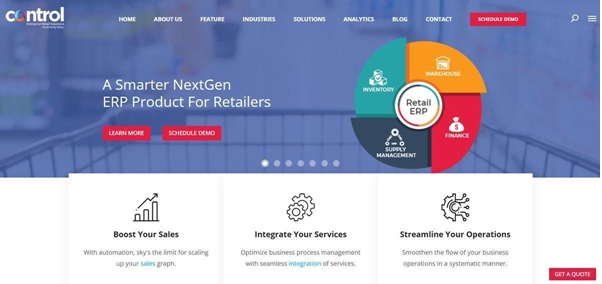
Control ERP is a Plano, Texas company whose Odoo-based platform for omnichannel retail comes with sales, purchasing, accounting, inventory, production, POS, CRM, HR and payroll, and eCommerce already joined, so a retailer starts from a working system and not an empty one.
Its commerce layer is the differentiator. Magento connects natively, the CRM is built for eCommerce, and marketplace connectivity is included, so online and offline sales run from one system. Odoo and Magento manage inventory together, which keeps web and store stock aligned. A case study on its site covers a New York equipment supplier founded in 1949 that moved off an AS/400 system to Odoo, cutting manual workload by 42% across an inventory of more than 200,000 SKUs.
Platform Highlights
- Omnichannel retail ERP on Odoo
- Native Magento integration
- Built-in marketplace connectivity
- Centralized multi-channel inventory
- Integrated POS, CRM and accounting
- HR, payroll and reporting in one system
Best for: retailers that need centralized inventory, marketplace reach, Magento integration and synchronized online and offline sales.
3. Nanobytes
Madrid-based Nanobytes is a Gold Partner with a large certified team, recognized by Odoo with the Ave Fénix award for rescuing the most troubled projects.
Best for: companies with a stalled or failing Odoo project that need a rescue partner.
4. Birtum Soluciones
Birtum Soluciones, in Barcelona, is an Odoo Gold Partner with 6 to 25 certified consultants that specializes in multi-company and multi-country implementations.
Best for: groups with several legal entities and countries to bring onto one system.
5. Cudio
Cudio, in Boston, focuses on manufacturing, omnichannel distribution and retail. Its founders ran their own omnichannel business on Odoo, and its profile lists 16+ years of Odoo experience, 50+ completed projects and 97% retention, with migrations from SAP, Dynamics, NetSuite, Oracle, Sage and QuickBooks.
Best for: complex omnichannel businesses moving off a legacy system.
6. Dynapps
Dynapps is an Odoo Gold Partner with teams in the Netherlands, Belgium and Valencia, Spain. Its Belgian teams are ISO 27001-certified, and its Spanish entity falls in the 26 to 100 certified consultant range.
Best for: Benelux and Iberian companies that need security certification and a larger team.
7. Cravit
Cravit is a Breda-based Odoo Gold Partner with more than 14 years on the platform and 100+ implementations, including work for clients in 20 countries. It holds ISO 27001 certification, reports 55 documented references at 96% retention, and typically works with mid-market and enterprise customers rather than very small ones.
Best for: European mid-market and enterprise buyers that want security credentials on paper.
8. Captivea
Captivea has been an Odoo Gold Partner since 2014, with a base in Orlando, Florida and major operations in France. It publishes dedicated Odoo practices for retail points of sale and for the automotive industry.
Best for: companies that want a transatlantic team spanning the US and France.
9. S4 Solutions
S4 Solutions, a Gold-tier Odoo partner, works with discrete manufacturers on ERP, MES, supply chain, warehouse and quality, and holds that the minimum process and technology should deliver the maximum value.
Best for: discrete manufacturers that need MES, warehouse and quality in one project.
10. VentorTech
VentorTech is a Gold-tier Odoo partner that works on warehouse, eCommerce, finance and legacy migration projects where integrations are the hard part. It belongs to the Best Odoo Partners Alliance and is a Zebra ISV partner.
Best for: mid-size and enterprise teams with integration-heavy, multi-company requirements.
When the Project Is Complex, Check the Gold Behind the Badge
Put these questions to every Odoo Gold Partner on your shortlist. Ask for:
- how multi-company, multi-country and multi-currency setups are handled
- how large data migrations from legacy systems are managed
- how security, access control and compliance are documented
- how integrations with existing enterprise systems are governed
- how the program is staffed over time, including senior consultants
- references from rollouts as large as yours
Complexity punishes optimism, so ask each partner what went wrong on its hardest project and how it recovered. Start with Brainvire for scale and Control ERP for the retail and eCommerce layer.